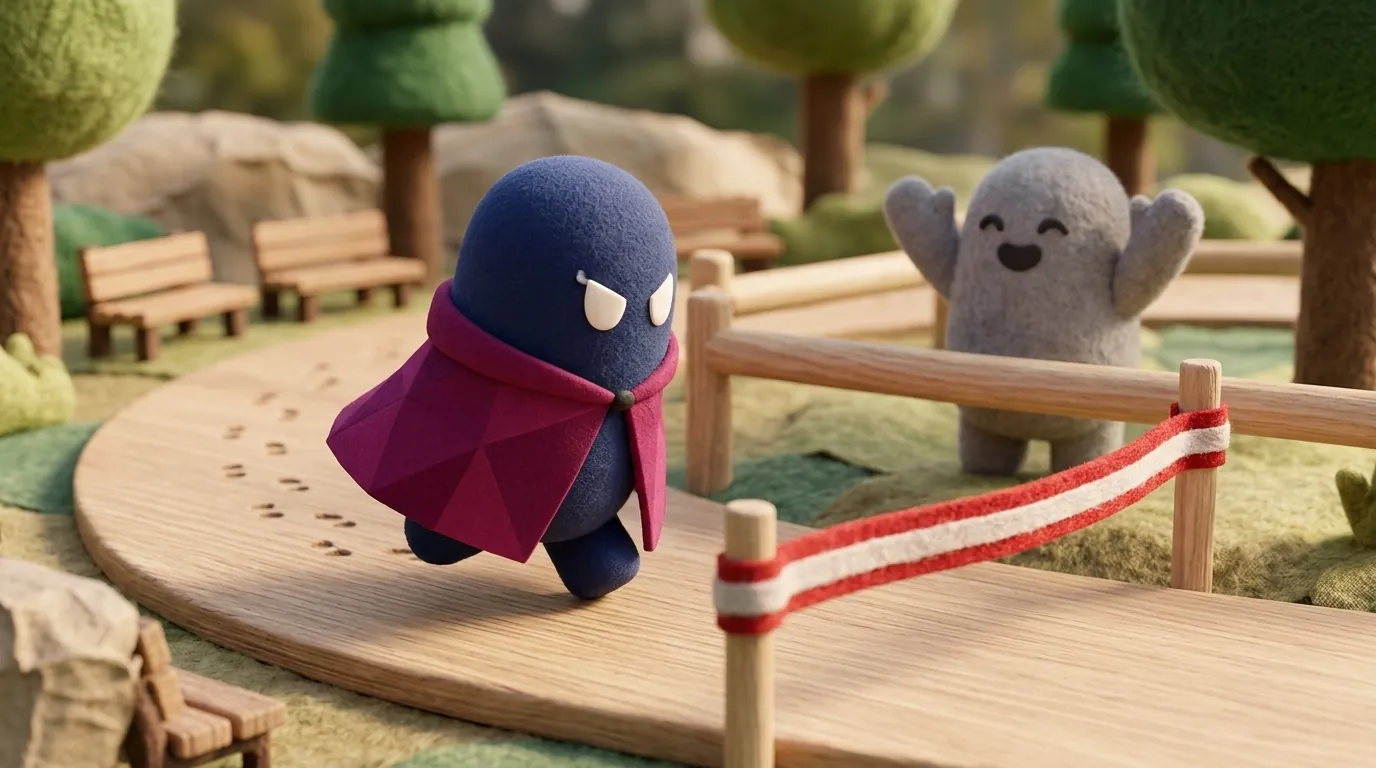
Goal-Gradient Effect: Why We Speed Up as We Near the End
The goal-gradient effect says motivation rises as you near a goal. What the evidence shows, how to use progress bars without backfiring, and the ethical limit.
What is the goal-gradient effect?
The basic idea is that motivation is not constant. When the goal is far away, it is hard to start. When it is close, people speed up. Laws of UX summarizes it as the tendency to approach a goal more as the distance shrinks (Laws of UX, “Goal-Gradient Effect”).
Its origin is in learning psychology. Clark Hull proposed the hypothesis in 1932, and Laws of UX recalls his 1934 work, in which rats in a straight alley ran progressively faster as they moved toward the food. Neal Miller refined it in 1944, according to the Kivetz et al. paper. That animal origin matters: Laws of UX notes that the implications for humans are understudied, so don’t treat it as a law.
What evidence exists in people?
The study most often cited in design contexts is Kivetz, Urminsky, and Zheng (2006). In a field experiment at a coffee shop, customers were randomly offered either a 10-stamp card or a 12-stamp card with two “bonus” stamps already on it. In both cases ten purchases were needed for a free coffee. Customers with the 12-stamp card took 12.7 days on average to complete it, versus 15.6 days with the 10-stamp card: about 20% faster (Kivetz, Urminsky, and Zheng, 2006; popular description at Ness Labs).
It is a good demonstration, but read it carefully. The study shows an effect on a loyalty card with a concrete reward. Ness Labs also notes that the effect depends on perceived power: people who see themselves in a position of low social or professional power are more motivated by proximity to a goal. It is not a universal law that applies the same way to every form.
Why should a designer care?
Because almost every long flow has an early stretch that asks for effort and gives nothing back. A ten-step form, an onboarding, or a profile setup can use the gradient if they show progress from the start.
A concrete example of good use: a “step 2 of 4” indicator in a checkout. It tells the person how much is left and reduces uncertainty. A progress indicator that doesn’t move during the first minutes does the opposite.
How do you use progress bars without working against people?
Irrational Labs reviews the evidence on progress bars (a meta-analysis, SurveyMonkey data, and an internal test) and concludes that they can help and also harm. Its practical recommendations include:
- Give quick progress early. One step completed on the first screen changes how the whole flow feels.
- Split long tasks into milestones. Showing “halfway there” is more useful than a bar with a hundred steps.
- Be careful with total times. In one of its tests, telling people a process would take 10 minutes reduced completion. It recommends not showing overall time estimates for tasks longer than five minutes without testing them first.
- Test the position. In the SurveyMonkey data it cites, a bar at the top of a survey increased drop-off, while a bar at the bottom improved completion (Irrational Labs, “Knowledge cuts both ways: when progress bars backfire”).
That last point is key: the bar is not neutral. What works in a five-question survey can fail in a forty-field form.
Example
Illustrative example: a health app has a six-screen onboarding to set goals. The team adds “Step 1 of 6 complete” after the first screen, which only asks for a name, and splits the rest into two blocks, “Your body” and “Your habits”. People who finish the first block move forward clearly. But the team also measures whether the bar on the third screen, with heavier medical data, causes drop-off. If it does, they move the notice to the end of the block and stop announcing the total number of steps in that part.
When NOT to use it
- When the progress is fake. Inflated progress that makes people feel they are doing fine is a dark pattern.
- When the goal harms the person. If the progress pushes someone to spend more or accept something they don’t want, the effect becomes manipulation.
- When the task is short. In a two-field step, a progress bar is unnecessary.
- When the bar stalls. An indicator that doesn’t move for a long time discourages more than having none.
The ethical line matters most. Showing real progress helps people finish something they want to finish. Inventing it to retain people or to sell changes the relationship. On that line, the signs of dark patterns are a useful reference.
Common mistakes
- Showing progress that doesn’t match real advancement.
- Starting the bar at zero and giving nothing in the first steps.
- Announcing a total step count that changes during the flow.
- Placing the bar at the top without testing whether completion improves or worsens.
- Applying the same indicator to every flow without measuring each one.
How to start tomorrow
Open your longest flow and count its steps. Check which step loses the most people. If progress isn’t visible until the end, add an indicator that shows progress from the first screen, with clear text (“step 1 of 4 complete”). Measure drop-off per step before and after. If the indicator makes its own section worse, change its position or its text. Then connect the result with loading states and the funnel analysis of the flow.