Participatory Design and Co-Design: When Users Decide With You
What participatory design and co-design are, their Scandinavian origins, how to run co-creation sessions, and when participation is only symbolic.
Where does it come from, and what does it mean?
IxDF describes participatory design as a collaborative approach that involves end users in the design process, with roots in Scandinavian human-computer interaction research of the 1970s and 1980s.
Kuhn and Winograd tell that story in more detail: the tradition began in Norway in the early 1970s, when computer professionals worked with unions so that workers had more influence on the design and introduction of computer systems at work. In the UTOPIA project, with the Nordic Graphic Workers’ Union, designers and experienced users worked together.
That root matters. Participatory design came from a labor and political question, not only a usability one: who decides how a person’s work is designed.
Why does this matter for a junior designer?
Because it is easy to say “we co-design with users” and end up with a session of sticky notes and a decision that was already made. A junior who understands the difference between real participation and symbolic participation can propose honest processes and avoid promising what the team will not deliver.
The participatory tradition also rests on an idea from UTOPIA that Kuhn and Winograd quote: good systems cannot be built by design experts who proceed with only limited input from users.
What is co-design?
Sanders and Stappers (2008) take co-creation to mean any act of collective creativity, that is, creativity shared by two or more people. By co-design they indicate collective creativity applied across the whole span of a design process, which makes it a specific instance of co-creation. They use it in a broad sense: the creativity of designers and people not trained in design working together in the design development process.
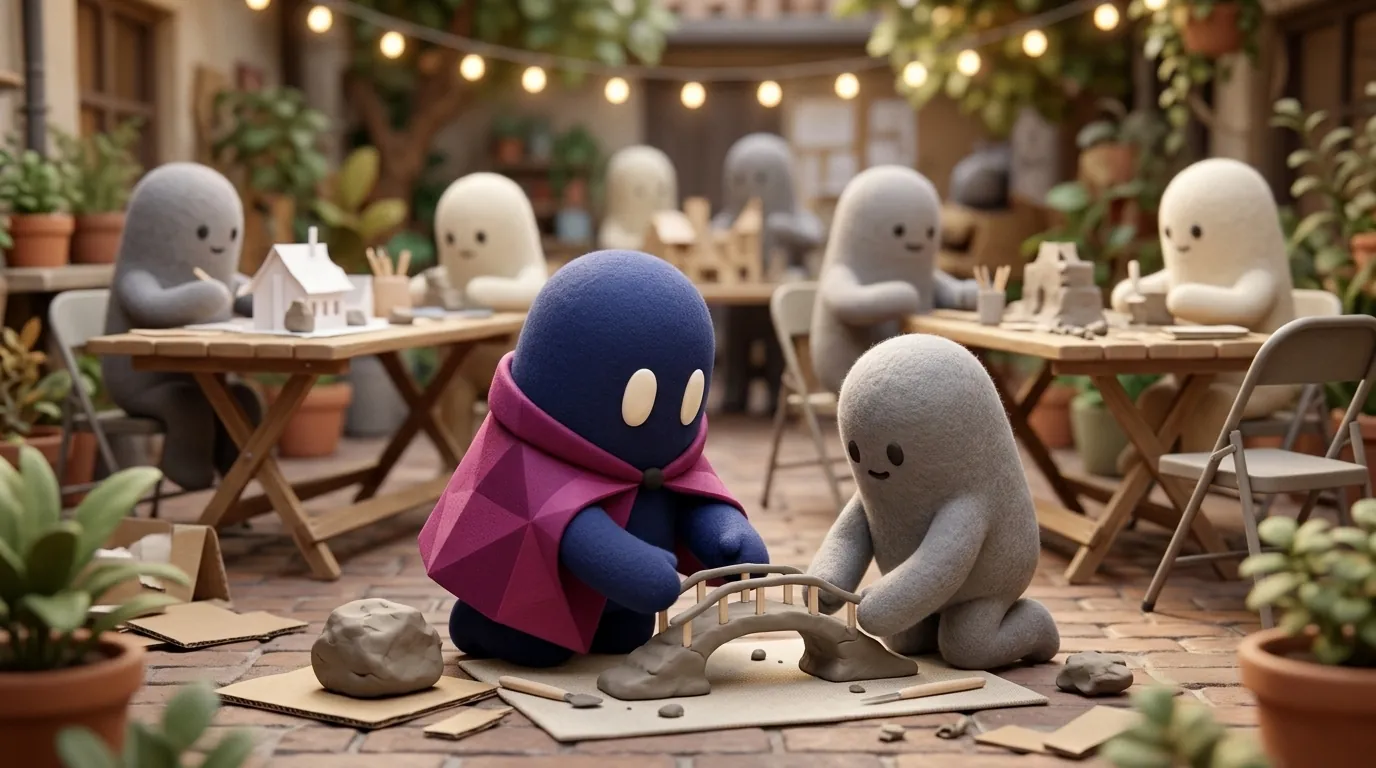
In practice, it means sitting with people and making something together, such as a mock-up, a list of problems, or a service map.
What is the difference between the two?
The sources do not draw a sharp line. IxDF presents co-design as another name for participatory design (alongside cooperative design and community design), and Sanders and Stappers define it as part of co-creation. If your team wants to separate the two concepts, present the difference as an internal convention, not as a quote.
One possible working convention, which does not come from those sources: in participatory design, users take part in decisions about the product; in co-design, something is created together in a specific session. Co-design can happen without real decision power, and that is the risk summarized in the next section.
What does recent research say?
A systematic review of 88 articles (Wacnik, Daly, and Verma, published in Design Science in 2025) describes participatory design as an iterative process that closely involves stakeholders, usually end users. In 65 of the 88 articles they took part across several design stages. The authors warn that the concept has become less rigidly defined, with stakeholders engaged to varying degrees through disjointed techniques, and that this ambiguous understanding can be counterproductive when discussing participatory processes.
The lesson for a team is simple: define what participating means in your case, at which stages, and with what power. If you cannot say it in one sentence, participation is probably not going to be useful.
How do you organize a co-design session?
- Define the decision to be made. If the decision is already made, do not run the workshop. A usability test may be a better choice.
- Choose participants for their relationship to the problem, not only their availability. Include people who use the product daily and people who suffer when it fails.
- Use materials that do not require design skill. Paper, sticky notes, cutouts, or a template with open questions. The idea is that everyone can contribute.
- Make each participant’s power explicit. Say what is decided in the session, what is not, and who makes the final decision.
- Close with feedback. Show what was incorporated, what was not, and why. Without that feedback, participation feels like a formality.
For discovery work in a short time, the article on design sprints describes a fixed-time format that can be combined with participation.
When should you NOT use participatory design?
- When participants cannot influence the decision. If the outcome is fixed, participation becomes a ritual that breeds frustration.
- When the population is hard to gather. A workshop with four people does not represent a community of thousands. In that case, combine participation with user interviews or observation.
- When the problem requires observing real behavior. Participation tells you what people believe or want. To see what they do, ethnography or contextual inquiry are better.
- When participation is used to legitimize a decision already made. It is the opposite of the original model, in which workers took part across the whole development cycle with real control over outcomes, according to Kuhn and Winograd.
Example
Illustrative example: a team redesigns a dashboard tool for nurses at a hospital.
- Decision: what information appears on the first screen during a shift. The team decides that with the head nurse, and it is not open.
- Participation: two co-design sessions with six nurses from different shifts. Each one sketches their ideal screen with paper and tape, and the matches are compared.
- Result: night-shift nurses want alerts to appear before tasks. That changes the priority of the screen.
- Feedback: the team shows the final screen and explains what changed because of the suggestions and what stayed because of safety requirements.
Participation did not change the underlying decision, but it changed the order of information. And the team was clear about what was not going to change.
If you want to see how synthesis of these sessions combines with AI, the article on AI interview synthesis shows what can be automated and what should be reviewed by hand.
Common mistakes
- Calling participation a session where the decision was already made.
- Choosing participants only for their availability.
- Using materials that require design skill and exclude most people.
- Not explaining what is decided in the session and what is not.
- Disappearing after the workshop without sending anything back.
- Treating a workshop with four people as if it represented the whole audience.
Sources
- IxDF, Participatory design
- Kuhn and Winograd, Profile: Participatory Design, in Bringing Design to Software (1996)
- Wacnik, Daly, and Verma, Participatory design: A systematic review and insights for future practice (Design Science, 2025)
- Sanders and Stappers, Co-creation and the new landscapes of design (CoDesign, 2008)