SCAMPER: structured ideation from what already exists
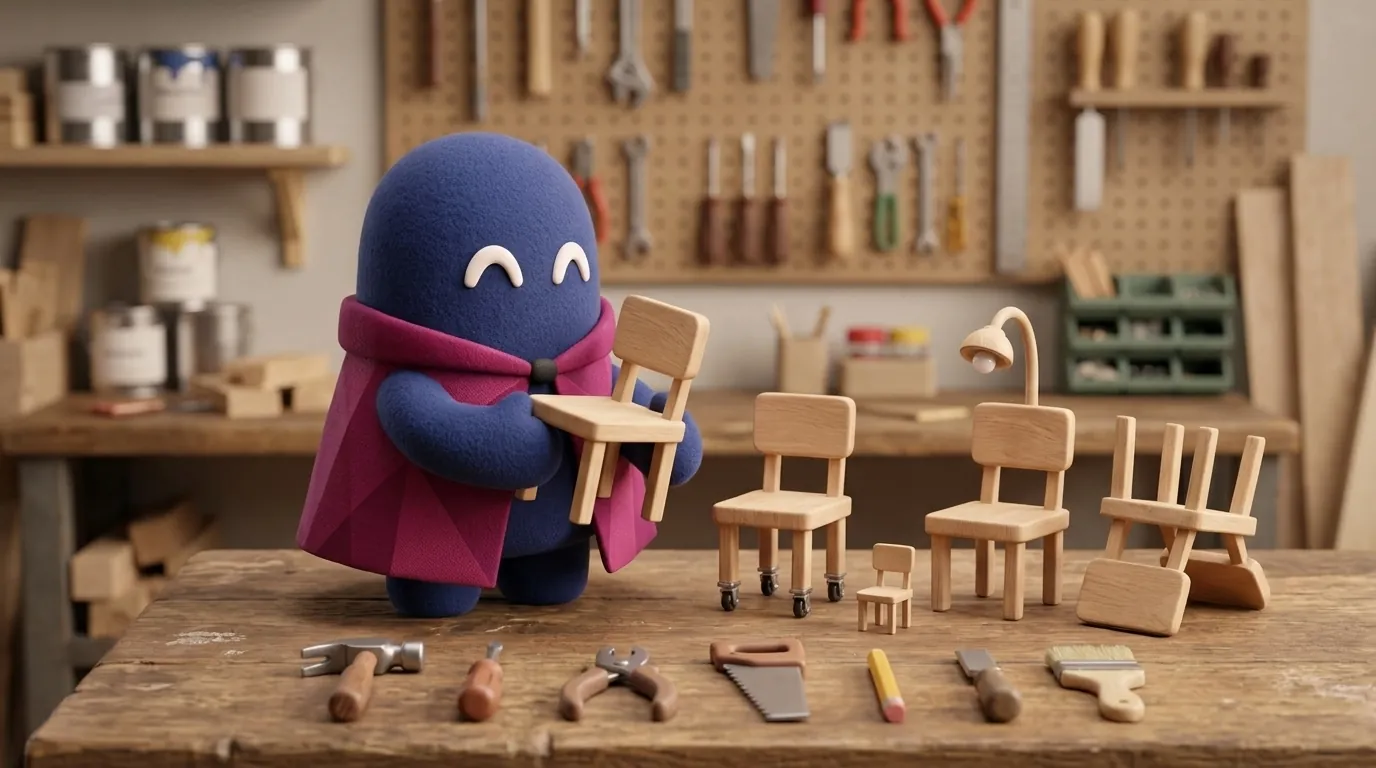
SCAMPER is seven prompts (substitute, combine, adapt, modify, other uses, eliminate, reverse) for generating ideas on something existing. Run it in a workshop.
What is SCAMPER?
It is an acronym that turns each verb into a question you apply to a product, process, or idea. Wikipedia describes its letters as Substitute, Combine, Adjust (or Adapt), Modify (which can also be Magnify or Minify), Put to other uses, Eliminate, and Reverse (or Rearrange).
The technique was developed by Bob Eberle, who was inspired by the checklist Alex Osborn described in Applied Imagination (1953). According to IMD, Osborn had eight prompts and Eberle reorganized them into the acronym, published in 1971 in SCAMPER: Games for Imagination Development. What is useful is not memorizing where each letter comes from, but running the whole list against your problem.
Why does it matter to a designer?
Because most design projects do not start from scratch. A flow gets redesigned, a feature gets improved, or a product gets adapted to a new market. SCAMPER gives a systematic way to look at what exists without repeating what everyone would do.
It also helps when a team stalls. A concrete prompt, such as “what if we removed this step?”, produces ideas faster than asking for “new ideas”.
What prompts do you use?
Each letter works as a general question. These are typical prompts you can adapt to your case:
| Letter | Typical prompt | Example in a payment flow |
|---|---|---|
| Substitute | What element can we swap for another? | What if the verification code were a confirm button? |
| Combine | What can we join with something else? | What if payment and shipping confirmation were one screen? |
| Adapt | What idea from another context can we borrow? | What does a ride-hailing app do when it confirms a trip? |
| Modify | What can we enlarge or shrink? | What if the pay button were much larger on mobile? |
| Put to other uses | What else could this be used for? | Could the payment history serve as a purchase reminder? |
| Eliminate | What can we remove without losing the goal? | Do we need to ask for a phone number before paying? |
| Reverse | What happens if we invert the order or the use? | What if users confirm the total first and choose the payment method after? |
You can write your own prompts as long as they carry the same intent: change, join, borrow from elsewhere, transform, redirect, remove, or invert.
How do you run a workshop?
Haaga-Helia, a Finnish university of applied sciences, describes a clear procedure for a one-hour workshop:
- Define the problem as a “How might we…?” statement, like the one in the How Might We page, or a part of it.
- Prepare a template printed on A3 or larger, with one column per prompt, plus pens, sticky notes, and a facilitator.
- Work in groups of up to six people, filling each column with new ideas. They can add their own questions.
- Hang the templates on the wall and leave five minutes to read them.
- Vote on the ideas with a quick voting method and write up the key learnings and a short summary.
Haaga-Helia suggests 45 to 60 minutes, with up to 15 minutes of preparation. A shorter version works as a warm-up, though it loses depth.
After voting, IMD suggests evaluating and prioritizing with criteria such as feasibility, impact, and alignment with the goal, and testing the promising ideas with users. You can run SCAMPER again on the result.
When should you NOT use SCAMPER?
SCAMPER works best on something that already exists. Without a starting point, it can be too abstract and the group ends up improvising. It can also produce ideas that sound good but do not solve a real problem if they are not connected to what users need.
IMD, in its article on the method, recommends generating ideas freely before judging them, to avoid premature criticism. That warning holds: the moment to judge ideas comes once the list is complete, not before. And since SCAMPER fits after the problem has been defined, make sure the challenge is clear, for example with the Double Diamond, before you call the workshop.
Example
Illustrative example: a team wants to improve the sign-up for a language-learning app, which has nine steps. In a 50-minute workshop, one group works through the seven prompts on the flow. When they ask what could be eliminated, they find that asking for a birth date is not necessary at first sign-up. When they ask what could be combined, they propose joining language choice and level on one screen. At the end they vote, and the idea of removing a step wins. The team tests the five-step version in a usability session the following week.
Common mistakes
- Applying it without a clear starting point, and letting the group improvise.
- Judging ideas while they are being generated, which stops production.
- Answering the seven letters with nearly identical ideas, due to lack of time or guidance.
- Skipping evaluation and leaving the list without a decision.
- Believing the technique guarantees good ideas: it widens the range, but validation is still needed.
If after the workshop you need to sketch the most promising ideas quickly, Crazy 8s speeds up visual production, and dot voting helps choose among options. To validate the chosen idea before building it, concept testing is the next step.